
A Minute and Multitudes
Our little lives and history and all those stars

I sometimes think the superpower I would most like is to be able to leap into another person’s experience for a day. Any person, anywhere. Just live as them for one day, experience the waking up, the aches and pains (or maybe none of them), the delicate little rituals, the furies and loves, the struggles and hugs and cups of coffee. The jobs, the commutes. All of it. Just live in another life and completely feel it. What might I learn about being human? What would it feel like to wake up in Ukraine or in a penthouse in Dubai or uncover my hair for my husband for the first time? What would come to mind first if I woke up as an unhoused person in a warm climate? What if I were a beggar in Sweden? A royal in Lagos? A mother in Kentucky, a dad in El Salvador, a grandmother, a four-year-old? There are so many humans on the earth I couldn’t possibly occupy each life for even a minute, but what if that’s why God made us? To experience everything about life?
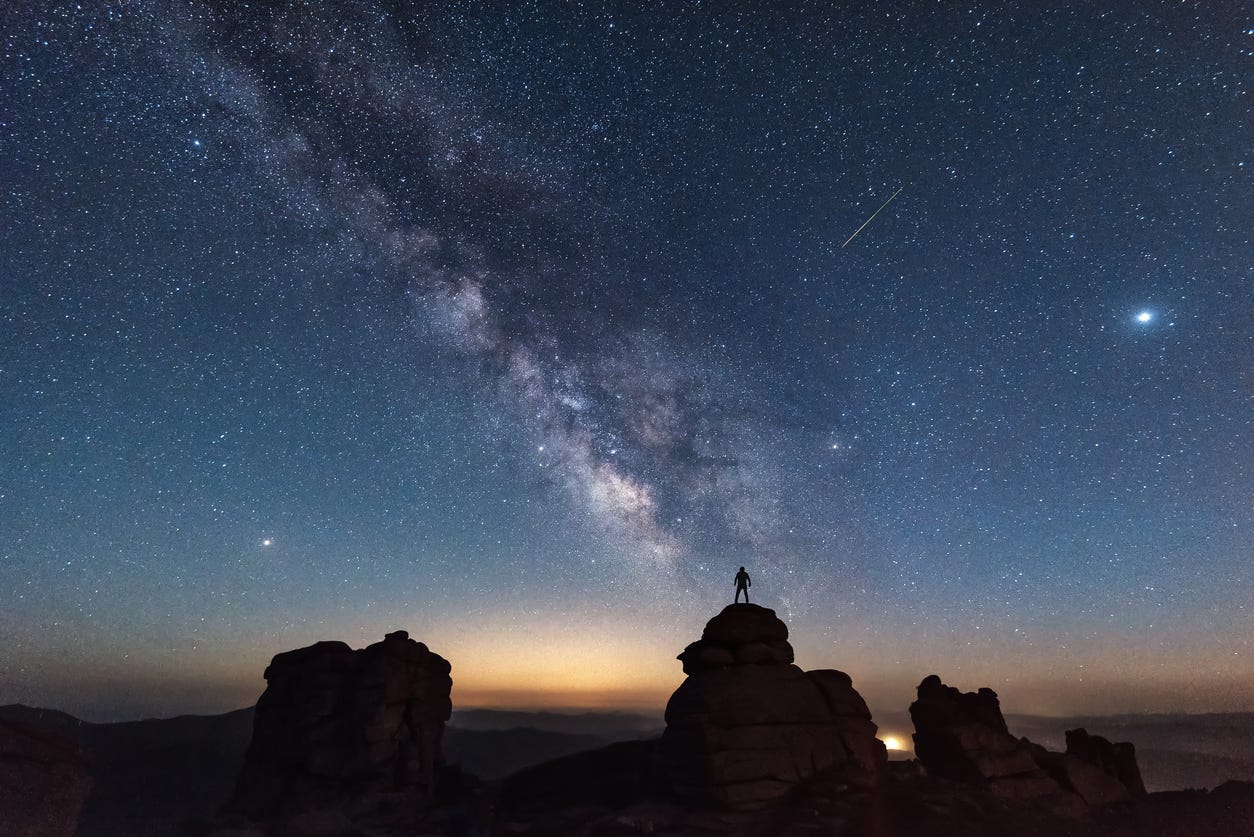
Upon moving to Bandon, I rediscovered the stars. I’ve always been enchanted, and had a chance to go camping in places where I could truly access the vastness of the Milky Way. But I’ve mostly lived in cities, and cities just get brighter and brighter, rendering the night sky with its wonders a pale imitation of itself. In Bandon, the skies are very dark. I can step out onto my balcony and stare upward in silent astonishment, admiring the constellations and the planets and sometimes the blue or green winking of some far away sun. Lying on my back to look at the sky, I always find it remarkable that there is nothing between my body and those far away places but air. There’s no ceiling, nothing to keep me from flying away into the vastness…except gravity.
Weird, right?
All of those stars are actually suns in their own little solar systems, and as a Star Trek child and a fan of old school science fiction, I wonder who lives on the even more multitudinous planets surrounding those suns. Who is on some other Earth, looking up at their sky, thinking about us? What do they look like? What do they eat? Are there cats there?
So many, many, many worlds. So many possibilities.
My husband and I are planning a trip to England. We haven’t been since the star-crossed Covid Trip of 2021, and I’ve been hungering for it. One place we want to return is Eynesford, a very old village with Roman ruins, which is a passion of my husband’s. He loved the place as a child, and I’m always bemused by how long ago the Romans lived there.
There is also a medieval castle ruin, and an ancient ford. As a child of the American west, I find the idea of living around that kind of documented history compelling, and the hunger to explore more deeply (deeper, deeper!) engages my imagination.
Of course, there are older places in England. The origins of Stonehenge are so shrouded in time that we don’t even know that much about them and why they exist. Built around the same time are the Pyramids, which intellectually I understand were built a long time ago, but then I read something that said while Cleopatra was alive, the pyramids were already so ancient that there were archaeologists studying them.
Think about that.
And the Pyramids don’t even touch the Sumerians and other Bronze Age civilizations, who were around 12000 years ago. I could go on, with China, Peru, India, but you get the picture.
Lately, I wonder who my ancestral mothers were. Who, back in the fifth century, was like me? My many-times-great-grandmother, a Celt most likely, in England or Ireland or France, with solid limbs and a gift for plants. Maybe she sang story songs rather than wrote them. Maybe she braided grasses into decorations for the hut she lived in. Does she know I’m here?
And who, twenty centuries from now, will be my descendant?
I’m old enough now to realize that I won’t be in this body forever, that eventually I will not be sitting in this aerie over the beach, watching seagulls and crows and turkey vultures sailing by. That there will not even be a memory of me, or even the room itself, or eventually, even the descendants I know and love right now.
On TikTok, I follow renowned physicist Brian Cox, who talks about the vastness of space, the enormity of numbers that make up the known universe. Hundreds of billions of galaxies, each with millions to billions of stars. Our own Milky Way is estimated to contain 100-400 billion stars.
Just our little galaxy. The possibilities make my heart shimmer.
But Cox postulates that the Fermi paradox or “great silence,” the fact that we have not heard from any of those other life forms, might point to the reality that they do not exist. That it takes such a rare combination of events to create and sustain life that grows to a point of intelligence and consciousness and then perhaps space travel that it might be that it has simply never developed anywhere else.
Which makes our existence even more miraculous than it already is.
And precious.
To be honest, I don’t know that I believe either of those theories—that we have not had contact, or that we are alone. Maybe I don’t want to believe it. I admit that I don’t.
Think of them—all those humans, creating an incredible mosaic of experiences, right now in this very hour. Think of all of their ancestors, and yours, stretching backward to Sumeria and Africa and places we might not know about. Think of all those suns, suns glimmering in the night sky, surrounded by planets making solar systems of various sizes, making galaxies upon galaxies.
And here I am, here you are, on this singular day, with our singular, unique lives, on this singular planet, spinning around our own particular sun, in the Milky Way.
Here we are.

So beautiful to read and contemplate your words.
I had never heard of the Fermi paradox! Interesting conjectures and thoughts. Thank you.